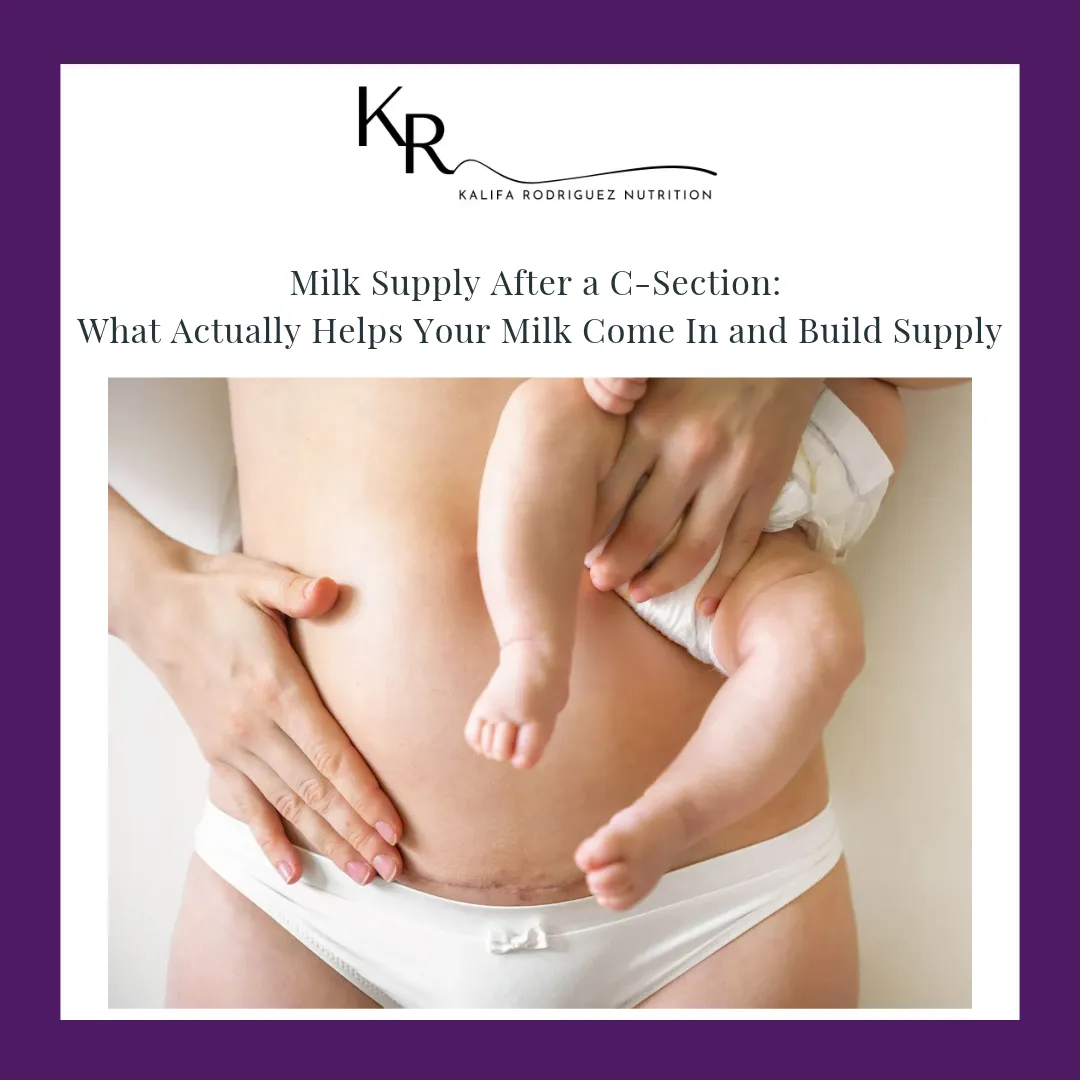
Milk Supply After a C-Section: What Actually Helps Your Milk Come In and Build Supply
“So when I tell a mother that a difficult beginning does not necessarily determine the rest of her breastfeeding journey, I'm not speaking only as a Registered Dietitian and Breastfeeding Specialist.
I've lived it."
I didn't expect to meet my 1st child at only 33 weeks pregnant, I also didn't expect to have an unplanned C-section. I never dreamed she would be too small and premature to breastfeed, I certainly didn't expect that one of my first experiences of feeding my baby would involve a breast pump instead of holding her at my breast.
While my body recovered from surgery and my milk production slowly began to catch up, my daughter received donated human milk in the NICU. At the time, I would of never guessed our story would eventually come full-circle.
Through weeks of exclusive pumping, and lots of trial-and-error, I gradually built my milk supply. Eventually, I wasn't just producing enough for my daughter, I was producing enough to donate my own milk to the milk bank that had once helped feed her.
So when I tell a mother that a difficult beginning does not necessarily determine the rest of her breastfeeding journey, I'm not speaking only as a Registered Dietitian and breastfeeding specialist.
I've lived it.
So, why can milk production be harder after a C-section, and what can you actually do about it?
After birth we experience the largest crash in hormones we will ever experience in our lives. Falling progesterone levels trigger secretory activation, the hormonal process responsible for increasing milk production, typically within 2–3 days. However, following a C-section, this process can sometimes be delayed beyond 72 hours.
Blood loss, maternal complications, pain, stress, premature delivery, separation from baby (the inability to latch baby to breast within the 1st hour of birth termed the "golden hour") ,and limited opportunities for early breastfeeding can all contribute.
Take heart mama, delayed milk production doesn't mean your body has failed or that breastfeeding is no longer possible, and I am living proof!
What If Baby Can't Breastfeed Yet?
When my daughter couldn't nurse, I'll never forget being loaned a hospital breast pump with flanges and parts (the flanges were all one size so my ideal flange size was never measured, and I had no idea there were even different sized options anyway), the nurse telling me I should try to pump but feeling so utterly lost. After a few frustrating trials and getting nothing but a few drops at a time I eventually I became more comfortable with my new routine and exclusive pumping became our bridge to breastfeeding.
Milk production operates largely on supply and demand. Frequent, effective milk removal signals your breasts to continue producing milk.
If your baby can't come to the breast yet, your pump can temporarily become your baby's voice.
What Actually Helps Build Milk Supply After a C-Section?
Start early: Begin breastfeeding, hand expression, or pumping as soon as possible. It takes a while for anesthesia to wear off, if you feel upto it, have someone set everything up for you and begin pumping even before you start trying to stand or walk around. If you can pump within the 1st hour of giving birth even better. I would mention this to your delivery nurse or midwife so they can have things all prepared ahead of time if needed.
Remove milk frequently: Aim for approximately 10-12 effective milk removals daily when establishing supply, with individualized guidance. Don't forget to pump overnight, it's when your milk production is highest!
Prioritize skin-to-skin: Once medically cleared start! Even preemie babies should be getting skin-to-skin, they may have lots of tubes and cords but your nurse will be able to help get both of you comfortably settled until you become comfortable arranging things on you own. Countless studies have shown how skin-to-skin greatly supports bonding and breastfeeding.
Manage pain and rest: Comfortable positioning and adequate pain relief make feeding and pumping easier. Don't forget to use the correct flange size, most hospitals carry sizes that are far too large.
Nourish your recovery: Eat enough, prioritize protein and iron-rich foods, and stay hydrated. Think bone broth, coconut water and smoothies.
What If My Supply Still Isn't Increasing?
Persistent low milk production deserves individualized assessment. Pump effectiveness, milk removal frequency, hormonal factors, and medical complications may need attention.
You don't have to figure everything out alone, speak with a professional specialized in breastfeeding and lactation (unfortunately many doctors and nurses don't have enough knowledge in this area and often present their own biases vs. evidenced-based guidance when it comes to breastfeeding).
A Full-Circle Breastfeeding Story
Through weeks of exclusive pumping, I gradually built enough milk to meet my daughter's needs and eventually donate to a milk bank. She also grew and developed to a point where we could practice latching and feeding at the breast, so I was able to supplement with my own pumped milk as she gained the skill of nursing.
The same generosity that helped nourish my daughter became something I could offer another family.
Not every journey ends with an oversupply, nor should it have to.
A difficult beginning doesn't have to define your breastfeeding story.
If you're struggling with milk supply after a C-section, book a breastfeeding consultation with me. Together, we'll explore what's affecting your supply and create a personalized plan to support you and your baby.
I also created Energize & Nurture, my nutrition course for breastfeeding mothers.
Inside, you'll learn how to nourish your body for postpartum recovery, support a healthy milk supply through evidence-based nutrition, build balanced meals even on your busiest days, and care for yourself without adding more stress to your plate.
Because when a mother is well nourished, she's better equipped to nourish her baby.
If you're ready to feel more confident in your breastfeeding journey and finally stop second-guessing every feeding, I'd love to support you virtually or in-person but please feel free to join my online course Energize & Nurture: A Nutrition Guide for Breastfeeding Moms.
And don't forget to join my email newsletter for more real, evidence-based postpartum nutrition support.
Sending you love and light,
xoxo